Why Do We Rewatch Movies?

Why watch a movie again when you already know what happens? You know who survives, who the killer is and how the story ends. Every two hours spent rewatching a movie could also have been spent discovering a movie you have never seen before. Still, sometimes the movie you want to watch is exactly the one you have already seen. There is even a name for deliberately choosing to experience something again: volitional reconsumption. Researchers have connected it with things like comfort, emotion regulation, nostalgia and social connection. But there is also a simpler way to look at it. The movie may be the same, but you are not.

Why choose a movie you already know?

A new movie is always a small gamble. Maybe it will be great. Maybe it will be boring. Maybe you will spend two hours waiting for it to get better and it never does. When you choose a movie you already know and like, most of that uncertainty disappears. You know what kind of experience you are going to get. After a long day, that can also make the choice itself easier. Instead of going through streaming services, reviews and watchlists, you can put on something familiar. For the next two hours, you know what is going to happen.

Knowing what happens does not necessarily remove the enjoyment. On a first watch, surprise can be important. On a rewatch, surprise can turn into anticipation. You know your favourite scene is coming. You know the line somebody is about to say. With a comedy, you may already know the punchline and still laugh at it. Sometimes knowing the characters makes jokes even better than they were the first time. Research about spoilers has even found that knowing the outcome of a story does not always reduce enjoyment. That does not mean everybody wants movies already spoiled for them, but it does show that not knowing what happens next is only one part of enjoying a story.

Some movies are also simply more rewatchable than others. Your favourite movie and your most rewatched movie do not have to be the same one. A film you consider a masterpiece might be emotionally exhausting, very long or something you only want to experience occasionally. Or just once. Another film might not even make your personal top ten, but somehow you have watched it fifteen times. Some films seem to invite another watch, while others can be excellent experiences that you do not particularly feel a need to repeat.

The comfort movie

Some movies become comfort movies. The idea is not very different from a favourite meal, a familiar place or a song you have listened to hundreds of times. You don't always want something new. Sometimes familiar things simply feel good. Sometimes you know that a particular movie will give you the kind of evening you want, and that is enough.

Comfort does not necessarily mean cheerful either. People also return to sad movies and movies they know will make them cry. A familiar sadness can be different from an unexpected one. You know where the story is going, how difficult it gets and how it ends. Sometimes, to cheer yourself up, you choose something funny. Sometimes when you're sad, you choose a sad movie too. Familiar movies can also require less effort when you are tired, sick or distracted. If you have seen a film ten times, you don't need to concentrate on every scene.

Do you rewatch it because you love it?

There is an interesting question behind all this: do you rewatch a movie because you love it, or do you partly love it because you have watched it so many times? It's a little bit like John Cusack's character Rob Gordon says in High Fidelity: “Did I listen to pop music because I was miserable? Or was I miserable because I listened to pop music?” The same question can be asked about movies.

In psychology, there is a term called the mere-exposure effect. Put simply, repeated exposure to something can under some circumstances increase how much we like it. So perhaps a movie was not watched ten times only because it was already your favourite. All those watches and rewatches may also have helped make it your favourite.

There are limits, of course. Sometimes you simply watch a movie so often that you get tired of it. But that does not necessarily mean you are tired of it forever. Come back to it five or ten years later and you may still remember the story and the important scenes, while many of the smaller details have faded away. The movie is familiar, but at the same time parts of it can feel new again.

This may also be one reason an annual rewatch can work so well. A year is long enough to forget parts of a movie without forgetting it entirely. Watching something again the following day, watching it once every Christmas and returning to it after twenty years are all rewatches, but they are very different experiences.

You never watch the same movie as the same person

The movie may be exactly the same, but the person watching it changes. A movie you first saw as a teenager can feel very different when you watch it decades later. Perhaps you once identified with the teenager in the movie and now understand the parent. Something that seemed incredibly important twenty years ago may now seem trivial.

This can be especially obvious when you rewatch something from your childhood. You understand things you did not understand back then, and some things that once seemed completely normal may now look very dated. So while the movie itself has not changed, you and the world around it have.

This is one reason a rewatch is not simply repeating the original experience. The movie gives you something that stays more or less constant while you change and evolve. Sometimes you are not only revisiting the movie. You are revisiting yourself.

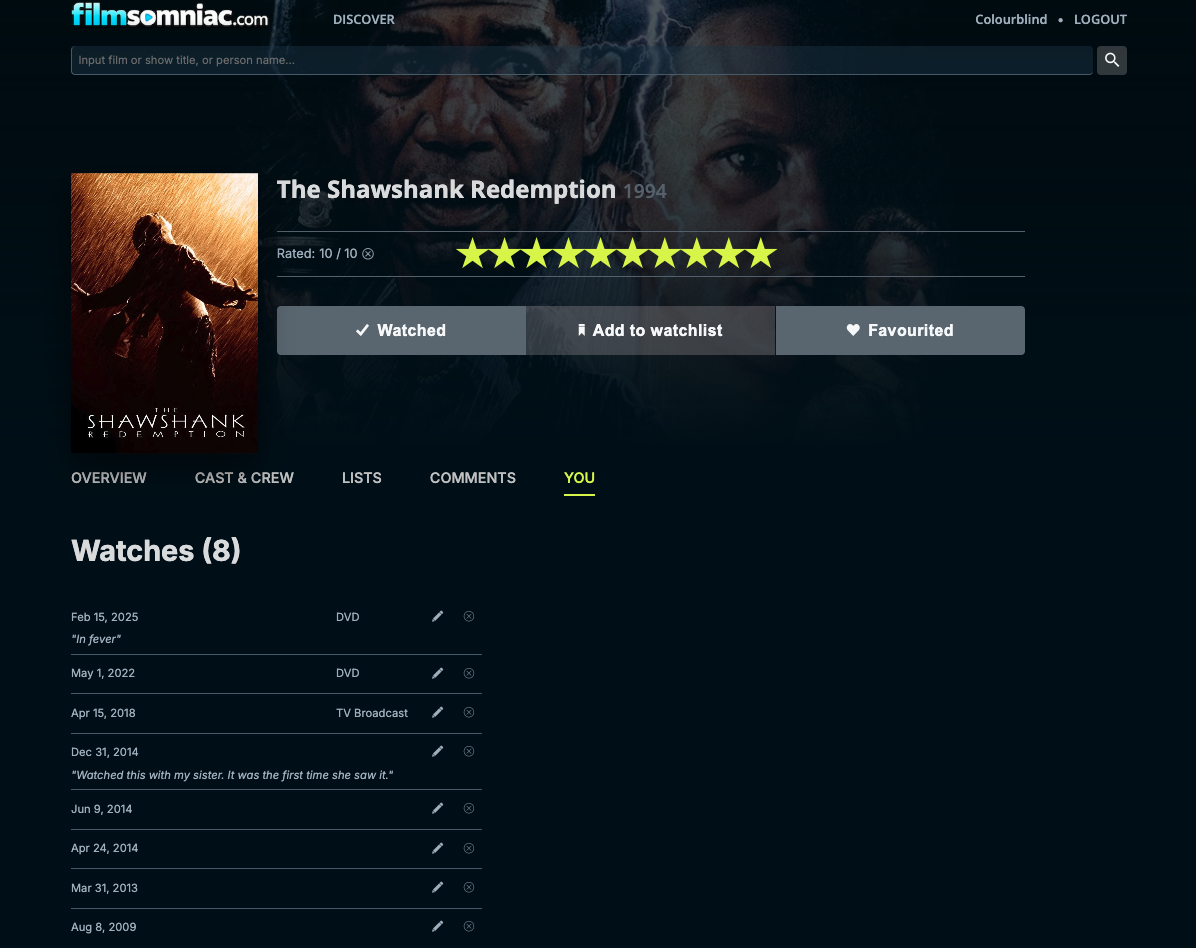
Eight watches of The Shawshank Redemption recorded in Filmsomniac

Movies are anchors to our memories

Movies can also become attached to periods and people in our lives. A movie may remind you of childhood, school years, a relationship, your first apartment or one particular summer. Sometimes only the opening music is enough to bring back the room where you first saw it and the people who were there. This is close to what I wrote earlier about movie diaries: often it is easier to remember events in your life through small, specific details.

Nostalgia is not only remembering old things. Psychological research has connected it with personally meaningful memories and with self-continuity, the feeling that your past and present selves belong to the same continuing story. A movie can become one of those connections. You can sit down in 2026 and watch the same movie you watched in 2001, and suddenly that earlier period of your life is not quite as far away.

When rewatching a movie becomes a tradition

Some movies eventually become more than just movies you happen to watch often. They become traditions. Christmas movies are probably the clearest example. People watch the same films every December, and eventually not watching them can feel stranger than seeing them for the fifteenth time. The same can happen with a particular movie every New Year's Eve, on a birthday or during a summer holiday.

An annual rewatch feels different from simply watching a movie frequently because it marks time. You watched it last Christmas, another year has passed, and now you are watching it again. Family traditions can make this even stronger. The movie doesn't even need to be good. The important part may simply be that you watch it together. Every year. After enough years, memories of the previous watches become part of the next one.

Favourite movies and franchises can also become part of identity. Saying that you are a Star Wars fan, a James Bond fan or somebody who loves horror can mean more than simply giving those films high ratings. People learn dialogue, recognise references and share quotes with friends. Sometimes the ritual grows beyond one movie into a franchise marathon or watching all the films of a favourite director.

Every rewatch counts

Filmsomniac is built around the idea that a movie is not simply watched or not watched. Every watch can be recorded separately, and rewatching is one of the clearest reasons why. If you have seen the same movie five times, those five watches do not have to mean the same thing.

Maybe you first saw the movie in a theater. Years later you watched it on DVD. Another watch was with someone important to you. One time you returned to it because you needed a comfort movie. Eventually watching it every December became a tradition. Filmsomniac lets those watches remain separate. You can save when you watched the movie, the format and, if there is something about that particular watch you want to remember, a note.

Over time those individual watches can tell the story of your relationship with a movie. Knowing that you have watched The Terminator tells you one thing. Knowing that you first saw it years ago, when you were definitely too young to be allowed to watch it, returned to it twenty years later and eventually started watching it regularly tells you something more.

A rewatch is not an identical twin of the first watch. You already know more about the movie, but more importantly, more has happened to you. You can watch exactly the same scenes, hear exactly the same dialogue and reach exactly the same ending.

But you never really watch the same movie twice. The movie may not have changed. You have.